The interesting thing about an AI stock analyst is not that it’s smarter than a human one. Most of the time, it isn’t.
What it has is capacity.
A good human analyst can carry maybe a few dozen names in real depth. The S&P 500 and the Russell 2000 together hold around 2,500 companies. So coverage becomes a rationing problem. You point scarce, expensive human attention at the names you already suspect are worth it, which means most of the opportunity set never gets looked at. The tell: every investor I know has a “we never got to it” list, and some of the best ideas quietly die there.
We built MungerMind for a client who wanted to flip that math. Rather than rationing human attention across a universe no person can read, the system reads the entire universe against a specific thesis, then surfaces the handful of names worth a real week of work.
See it run
A short walkthrough of MungerMind running in production.
How it works
MungerMind runs on a deliberate division of labor. We feed the model the hard facts. We let the model go find the story.
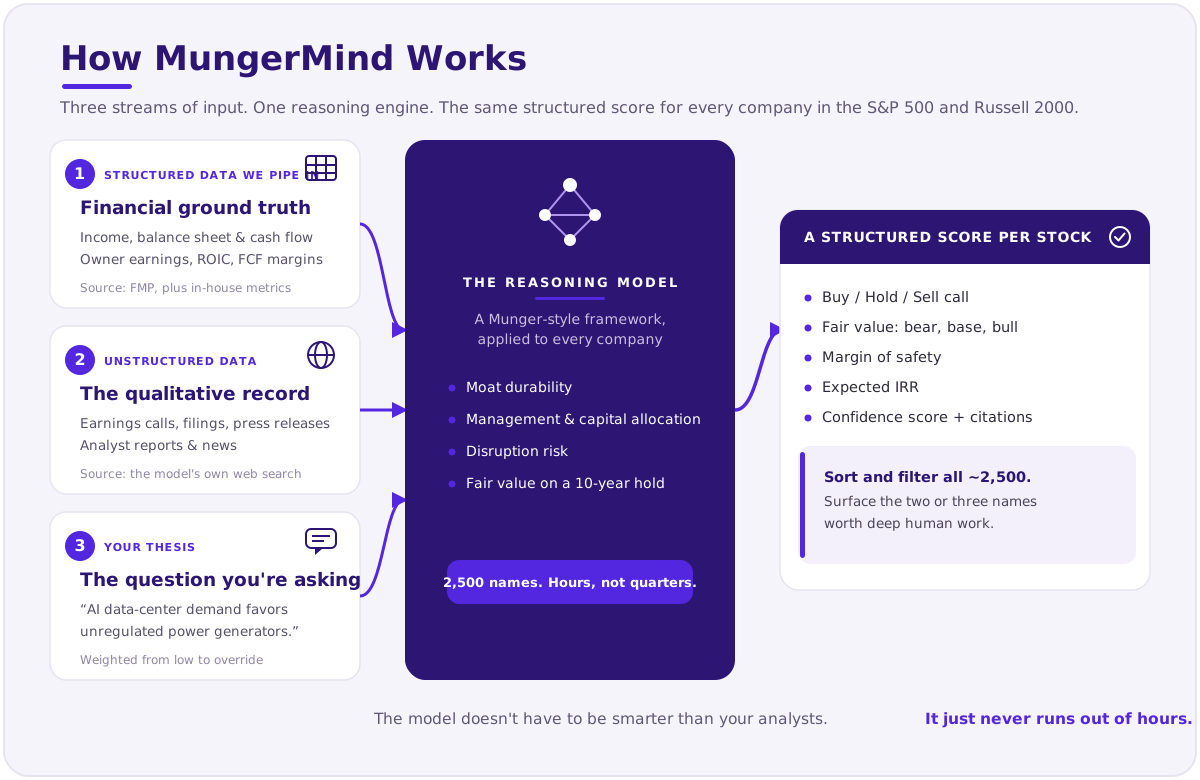
The hard facts arrive as structured data: years of income statements, balance sheets, and cash flow statements for every company, plus a set of metrics we compute ourselves. The center of gravity is owner earnings, the Buffett measure of what a business actually produces for its owners after the spending required to stand still. We treat stock compensation as the real cost it is, and we separate the capital a company spends to maintain itself from the capital it spends to grow. On top of that we calculate return on invested capital, free cash flow margins, debt coverage, and long-run growth rates. This is the deterministic ground truth, and it does not change based on the model’s mood.
The story is what the model sources on its own. It uses its own web research to pull earnings-call transcripts, press releases, analyst reports, and company filings, then weighs them against a source-credibility hierarchy so a Reuters story counts for more than an anonymous post.
Then it reasons. Every company runs through the same Munger-style framework: how durable is the moat, how capable is management, how well do they allocate capital, what could disrupt them, and what is a fair price assuming a ten-year hold. The output is structured and identical for all 2,500 names. A buy, hold, or sell call. A bear, base, and bull fair-value range. The implied margin of safety, an expected annual return, a confidence score, and the citations behind every claim. Small caps get a version of the framework tuned for thinner data and higher survivorship risk, because a Russell 2000 microcap cannot be judged like a megacap.
Because the format is the same for every company, the whole universe behaves like a spreadsheet you can sort and filter. Show me every wide-moat business trading below its base-case value with a double-digit expected return. One query, 2,500 names considered.
One more thing matters, and it matters for trust. Every analysis stores its own inputs, the exact version of the framework that produced it, and the date of the data it ran on. You can always see why the system said what it said, and you can hold today’s view up against last quarter’s.
Bring your own thesis
A screen is only as interesting as the question you ask it. So the thesis is a first-class input. A user can hand MungerMind a specific view (“Rising electricity demand from AI data centers favors unregulated power generators”) and the system re-reads every company through that lens. It reports, name by name, how the thesis changes the picture: which valuations move, which scenarios it touches, and where it conflicts with the data. If your thesis assumes strong management but the numbers show years of dilution and falling returns on capital, it tells you. A thesis that only ever confirms itself is worthless.
Capacity is the product
Here is the part that still feels strange. MungerMind can run that entire 2,500-company universe against a fresh thesis in a matter of hours. Not a sampled subset. All of it. A single name takes minutes, and the rest is just multiplying that by the market.
But speed is not really the point. The point is what the speed buys you. Our client does not use MungerMind to replace their analysts. They use it to aim them. The system reads all 2,500 names so that two or three rise to the top, and those two or three are where the humans go deep, where judgment and relationships and real diligence earn their keep. The machine handles breadth. The people handle depth.
That is the trade worth understanding. AI did not make the analyst obsolete. It removed the ceiling on how much ground one analyst can cover before the real work begins.
The question for an investor is no longer which names can we afford to look at. It is what do we want to ask the entire market, and who do we trust to chase down the answer.