I keep having the same conversation with different founders and operators. They’ve watched an AI agent do real work, they’ve decided they want “AI employees,” and their first question is which agent framework to use. It’s the wrong first question. The phrase “agent framework” collapses three genuinely different jobs into one word, and almost every confused debate in the agent space traces back to that collapse.
Here’s the sentence I anchor everything to: the harness makes it think, the runtime makes it an employee, and the control plane makes it a workforce.
Three jobs, three layers, three different build-or-buy decisions. Get those boundaries right and the rest of the architecture mostly falls out on its own.
Chatbots, agents, and employees
First, definitions, because the words get used interchangeably and they shouldn’t be. A chatbot answers when you open it. An agent completes a task when you launch it. An employee is a different thing entirely: it has a name and an identity, it remembers you between conversations, it shows up on a schedule and does work nobody asked for in the moment, and it answers messages on the channels you actually use.
I run my company this way. An AI chief of staff triages my inbox and manages my calendar. An AI finance lead tracks expenses and produces reports. An AI QA lead validates work against acceptance criteria before anything ships. These aren’t automations I trigger. They’re colleagues I message, and they message me first when something needs my attention.
The question is what it takes, architecturally, to get from impressive demo to dependable colleague. The answer is a stack of five layers, and each layer has exactly one job.
The five layers
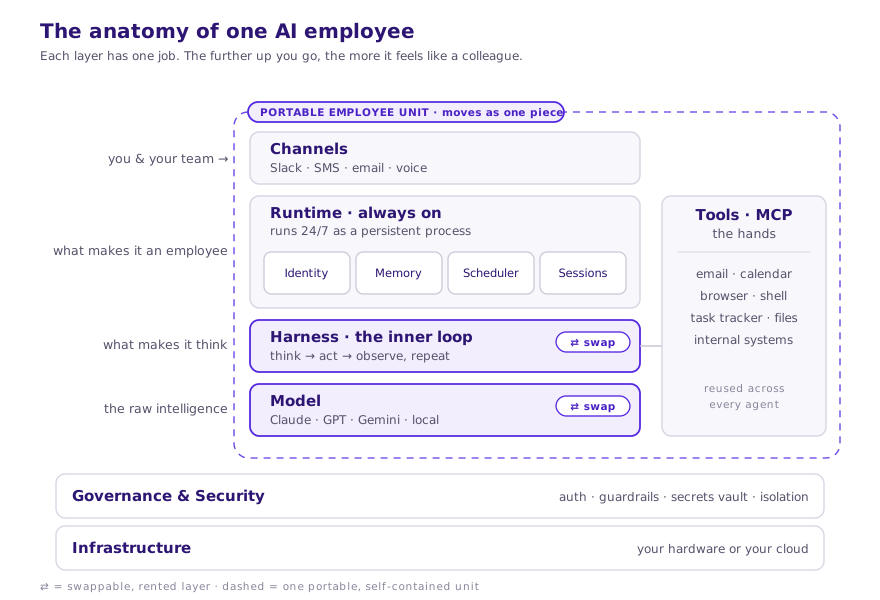
Model: the mind. Raw intelligence. Claude, GPT, Gemini, or a local model. It knows things and can reason, but on its own it does nothing and remembers nothing. This is the most swappable layer, and you should treat it that way from day one.
Harness: the thought. The inner loop: think, act, observe, repeat, while keeping the context window coherent along the way. Give it a task and it loops until the task is done. Then it stops existing. That last part matters, because a harness is a single train of thought that ends. The harness is also increasingly commodity. The frontier labs improve products like the Claude Agent SDK and the Vercel AI SDK constantly, and effectively for free, which is exactly why you should rent this layer rather than build it.
Tools: the hands. How the agent touches the world: email, calendar, browser, shell, the task tracker, your internal systems. Standardize tools on MCP (Model Context Protocol) and something valuable happens: the same tool works behind any harness and any model. Tools are the most reusable asset in the entire stack. Build them once and they survive every other swap you will ever make.
Runtime: the body, and the job. This is the layer that turns a program that can think into an employee. It runs 24/7 as a persistent process. It holds the agent’s identity and durable memory, runs its schedule so it acts unprompted, manages its sessions, and connects it to the channels people reach it on. Everything on the list of what separates an employee from an agent lives here. If you’re going to own and differentiate on one layer, this is the one. You also don’t have to start from zero: open-source runtimes like OpenClaw exist precisely so you can fork one and shape it.
Channels: the ears and mouth. Slack, SMS, email, voice. How you and your team actually talk to the employee. Part of the unit, but a thin edge of it.
Underneath all five sit two shared foundations that belong to no single layer: governance and security (authentication, guardrails, a secrets vault, isolation), and infrastructure (the hardware or cloud everything lives on).
The two seams that matter
The boundary between two layers is where the kind of job changes, and two of those boundaries do most of the work in this architecture.
The Employee-Maker Line sits between harness and runtime. A harness that finishes its loop and exits is a function call. Wrap it in a runtime and it becomes a colleague: named, persistent, scheduled, reachable. When someone demos an “AI employee” that only exists while a task is running, they’re showing you a function call with a personality.
The Workforce-Maker Line sits between runtime and control plane. One runtime runs one employee. The moment you have several, you need a layer above the runtimes that provisions new ones, watches their health, pushes upgrades, isolates them from each other, and meters what each one costs. A runtime is a worker. The control plane is the management, HR, and IT department for the whole workforce.
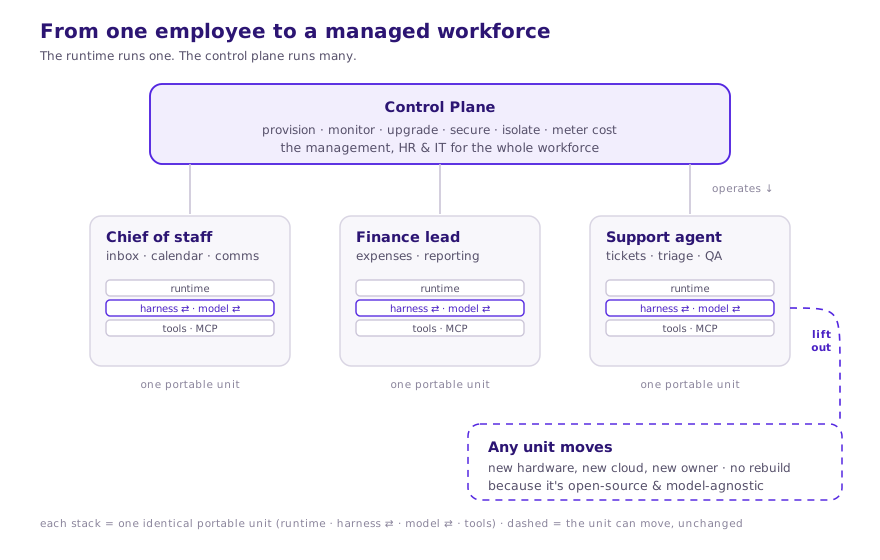
Most teams discover the second seam the hard way. The first AI employee is a delightful side project. The fifth is an operations problem. By the tenth, you’re running payroll, performance reviews, and security badges for a workforce, whether you built the systems for that or not.
Own what differentiates, rent the commodity
Once the layers are separate, the build-or-buy answers get simple:
- Rent the model. It’s the fastest-improving, most interchangeable part of the stack.
- Rent the harness. It’s thin, it’s commodity, and the labs improve it for free.
- Own the tools. MCP servers are reusable across every agent you’ll ever run.
- Own the runtime. Identity, memory, and how your employees work is where the differentiation lives.
- Own the control plane. Nobody else knows how your workforce should be managed.
- Buy observability. Tracing platforms like Langfuse and LangSmith already do this well.
Four design rules follow:
- Customize in configuration and skills, never in core runtime code. Every employee runs the same upgradeable runtime. What varies is declarative config and skills. Break this rule and each employee becomes a divergent fork. Divergent forks are maintenance death.
- Keep the harness and model behind thin interfaces. That’s what keeps the swappable layers actually swappable when the landscape shifts. And it will shift.
- Make every tool an MCP server. Same reason, other direction: the tool survives every change above it.
- Isolate by deployment, not by in-process multi-tenancy. Each employee, or team of employees, gets its own isolated unit. Isolation and portability both come free with the deployment boundary.
One caution: the managed cloud agent runtimes (AWS Bedrock AgentCore, Azure AI Foundry, Google’s Vertex AI Agent Engine) are excellent, but they weld your employee to one cloud’s control plane. If portability matters to you, and if you’re building a workforce you expect to run for years it should, that’s a real cost.
The unit that travels
Put the pieces together and you get the payoff of the whole design: model, harness, tools, runtime, and memory form one self-contained, portable employee unit. The control plane and infrastructure sit outside it. Because the unit is open-source at the bottom and interface-bound in the middle, it moves: new hardware, new cloud, new model, even a new owner, with no rebuild. An AI employee built this way is an asset you own, not a subscription you’re renting.
Where to start
Not with ten employees. With one. Stand up a single runtime, give it a name, a memory, a schedule, and three or four MCP tools, and put it on a channel you check every day. Then live with it for a month and fix what grates. The control plane can wait until employee number three. The seams can’t wait at all: if the harness and model aren’t behind interfaces from the first week, you’ll pay for it every week after.
The question worth asking isn’t whether AI agents can do real work. They already do. The question is whether you’ll run them as tools somebody occasionally picks up, or as employees somebody actually manages. Tools cap out at saving time. Employees compound. And the companies that learn to manage an AI workforce first are going to be genuinely hard to catch.