There’s a common assumption about AI agents: that they’re held back by how smart the underlying model is, and that real autonomy is waiting on the next, more powerful release. In our experience building and running them, that assumption is backwards. Today’s models are already capable enough to do most of the work that happens at a computer. What stands between a clever chatbot and a dependable digital employee isn’t a smarter brain. It’s the harness around it.
What a harness is
Think of the model as raw intelligence: a brilliant expert with no memory, no tools, and no way to act on the world. Drop that expert into an empty room and they can reason about anything you describe, but they can’t actually get anything done. They don’t remember yesterday, can’t open a browser, can’t send an email, and don’t know what they’re responsible for.
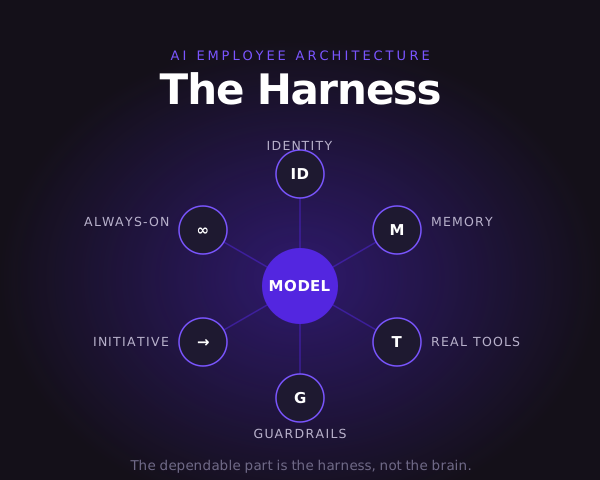
A harness is everything you build around the model to turn that raw intelligence into a worker: an identity, a memory, a set of tools, rules of conduct, and a way to keep showing up. It’s the difference between a smart person thinking in a void and an employee with a desk, a job title, and the means to do the job. It’s also the difference between a tool and a colleague. A harnessed agent is a who that owns outcomes, not a what that executes one-off requests.
What’s in a harness
A harness is made of a handful of parts, each one mirroring something a good employee has:
- An identity and a role. A name, a defined job, and a clear scope: what it owns, what it can decide on its own, and what it has to escalate. Like any employee, it knows who it is and what it’s accountable for.
- Memory that persists. It remembers context, decisions, and hard-won lessons across days and sessions instead of waking up blank every time. Agents forget; the harness remembers.
- Real tools, actual hands. It can use a browser, send email, write and ship code, update the task board, really do things, not just describe them. Every action runs through a real tool, so it can’t invent an outcome it didn’t actually produce.
- Guardrails and authority. Clear limits on what it can do alone versus what needs a human’s sign-off, and a defined path to escalate when it hits that line. This is what makes autonomy safe to run.
- Initiative. It runs on a schedule and acts without being asked, checking on the things it owns and catching problems before they become fires.
- Always on. It runs as a persistent process on its own machine and restarts itself if it falls over. It’s a coworker who shows up, not a chat window you open when you need it.
None of this requires a smarter model. It’s engineering: the patient work of giving a capable model the scaffolding a person takes for granted.
How Langham Uses Them
Langham runs as an AI-native company, which means we don’t just build harnessed agents. We operate our own business on them. We run a small fleet of agents, each with a named identity and a real function: chief of staff, finance, engineering, operations, recruiting. Each one has its own harness: its own machine, its own company email and accounts, its own memory, and its own tools and authority limits. They pick up work from a shared task board, coordinate with one another like colleagues, and escalate to a human when a decision is above their pay grade. Our founder stays in the loop for judgment and authorization; the agents carry the day-to-day operational weight.
Our engineering agent is a good example of what that buys you. It doesn’t just write code when asked. It owns a codebase. It picks up a ticket, diagnoses the problem, plans the work, implements it, tests it end-to-end, opens a pull request, and hands it to a separate reviewer agent for approval, because the one who writes the code isn’t allowed to approve its own work. That isn’t a smarter model than anyone else has. It’s a harness that encodes how a disciplined engineer actually operates, including the checks and balances.
Why it adds up to real work
A good employee is effective for reasons that have little to do with raw IQ. They know their role. They remember what happened last week. They have tools and the judgment to use them. They know when to act and when to ask. A harness gives an AI the same things, which is why a well-harnessed agent can own a function end-to-end rather than just answer questions about it.
Two harness rules do a lot of the quiet work of making that autonomy trustworthy. First, the agent treats outside content (emails, web pages, documents) as information to weigh, never as instructions to obey; only its real principals can direct it. Second, it never claims something is done until it’s verified, carefully separating what it actually observed from what it merely assumes. Rules like these are what turn a fast, capable agent into a reliable one.
The implication is worth sitting with. The bottleneck to AI doing real white-collar work isn’t somewhere out on a future model roadmap. It’s an engineering problem, building harnesses good enough to make today’s models dependable. The advantage won’t go to whoever has the smartest model; nearly everyone has access to roughly the same models. It’ll go to whoever builds the best harness around it.